BCI Funding Hit $1.15B in 2025. Where Are All the Early-Stage Founders?
4 min read

The numbers look extraordinary on the surface.
In 2025, brain-computer interface companies raised more venture capital than in any prior year on record — over $1.15 billion. In early 2026, that pace accelerated: Merge Labs, Sam Altman's BCI research lab, closed a $250 million seed round at an $850 million valuation with OpenAI writing the lead check. Synchron raised a $200 million Series D to fund its FDA pivotal trial. Neuralink completed a $650 million Series E, valuing the company at $9 billion. By February 2026, BCI companies had already raised $516 million — a 799% increase over the same period a year prior.
By all appearances, the BCI moment has arrived.
But spend a few weeks actually looking for early-stage BCI founders, and a different picture emerges.
The capital is real. The distribution is not.
The BCI funding surge is not flowing evenly across the ecosystem. It is concentrating at the top.
Over the past decade, the BCI sector has attracted roughly $3.89 billion in total disclosed funding. Of that, late-stage rounds absorbed $2.28 billion. Early-stage rounds took $1.24 billion. Seed-stage funding — the capital that reaches founders when they are still figuring out their hardware stack, regulatory path, and core scientific thesis — accounted for just $170 million. That is less than 5% of a decade's worth of capital flowing to the stage where founders need it most.
This is not unique to BCI. Across venture capital broadly, the trend toward concentration has intensified. In Q3 2025, 60% of global venture capital went into rounds of $100 million or more. Early-stage deal counts have been declining even as total dollars invested remain elevated. The rare exception is AI, which has attracted a disproportionate share of attention and capital at all stages. BCI, which sits at the intersection of neuroscience, hardware engineering, and machine learning, is not getting the same treatment — despite being one of the few fields that could plausibly produce technology as consequential as AI itself.
The result is a paradox: one of the most technically serious fields in deep tech is also one of the most undercapitalized at the earliest stages, precisely when foundational choices about signal acquisition, form factor, and clinical pathway are being made.

Why early-stage BCI is structurally harder than it looks
The concentration of capital at late stages is partly a rational response to risk. BCI companies take a long time to mature. The regulatory path through the FDA — even for non-invasive devices — involves clinical validation frameworks that software companies never encounter. Hardware development requires iterative prototyping cycles that cannot be compressed the way software shipping can. The science underneath the product has to be defensible to neurologists, biomedical engineers, and regulatory reviewers simultaneously.
All of this means that the 774-day median gap between a seed round and a Series A, difficult enough for software companies, is likely even longer in neurotech. Investors who operate on conventional fund timelines face structural mismatches with BCI's development cadence. The result is that generalist early-stage VCs often pass — not because the science is uninteresting, but because they cannot model the risk in a way that fits their portfolio construction.
This leaves early-stage BCI founders with a narrow funnel: specialized medtech funds that tend to prefer companies with existing clinical data, hardware accelerators like SOSV's HAX that cover adjacent territory, and a thin layer of angel investors who understand the domain. For a founder building a closed-loop neurostimulation device or a novel EEG signal processing pipeline, the early funding landscape is genuinely sparse.
The other problem: invisibility
Beyond capital, there is a more basic structural gap that rarely gets discussed.
The BCI companies that are visible — Neuralink, Synchron, Precision Neuroscience, Paradromics, BrainCo, NeuroXess — were almost all founded five or more years ago. They have press coverage, investor backing, and enough public presence to be findable. The early-stage founders building right now are largely invisible: working out of university labs, running stealth hardware experiments, navigating their first IRB submissions, trying to figure out whether their signal acquisition approach will hold up outside controlled conditions.
These founders exist. The BCI ecosystem is genuinely growing. China alone is seeing an explosion of new entrants — NeuroXess, NeuralMatrix, Gestala, StairMed Technology, and others are racing to commercialize both implantable and non-invasive approaches, backed by an 11.6 billion yuan ($165 million) national brain science fund announced in late 2025. In the US and Europe, new teams are emerging from research groups at MIT, Harvard, Berkeley, and UCL. The field is producing more founders than it was five years ago.
But there is no obvious place where these founders find each other.
This matters more in BCI than in most categories. A generalist founder working on a SaaS product can learn from other SaaS founders even if those founders work in completely different markets. The operational challenges of software — hiring, product-market fit, go-to-market strategy — transfer across industries. BCI is different. The hardware constraints are specific. The regulatory path is specific. The challenge of collecting clean neural signal in naturalistic real-world settings, as opposed to controlled lab conditions, is specific. A BCI founder trying to get useful feedback from a generalist founder community is asking the wrong room.
What they need is a room full of people who have argued with an IRB, who understand what ecological validity means and why it matters, who have thought hard about electrode impedance and artifact rejection and the tradeoffs between channel count and power consumption.
That room does not really exist yet.
What this means for the field
The combination of thin early-stage capital and a fragmented founder community creates a specific failure mode: technically serious BCI companies that never develop the peer relationships and adversarial feedback loops they need to harden their core assumptions before hitting the capital markets.
The companies that survive to Series A are not necessarily those with the best science. They are those that found — somehow — the right mentors, the right early customers, the right scientific collaborators, who helped them validate their core technical claims before they ran out of runway. That process is currently governed more by luck and network accident than by any systematic structure in the ecosystem.
The BCI field is moving from research curiosity to capital-intensive commercialization race faster than most people expected. Synchron is targeting its FDA pivotal trial in 2026. Precision Neuroscience may have already filed the first BCI premarket approval submission. Apple released a BCI Human Interface Device protocol in 2025. The infrastructure for a much larger industry is being laid down right now — by companies that were founded when the current wave of early-stage founders was still in graduate school.
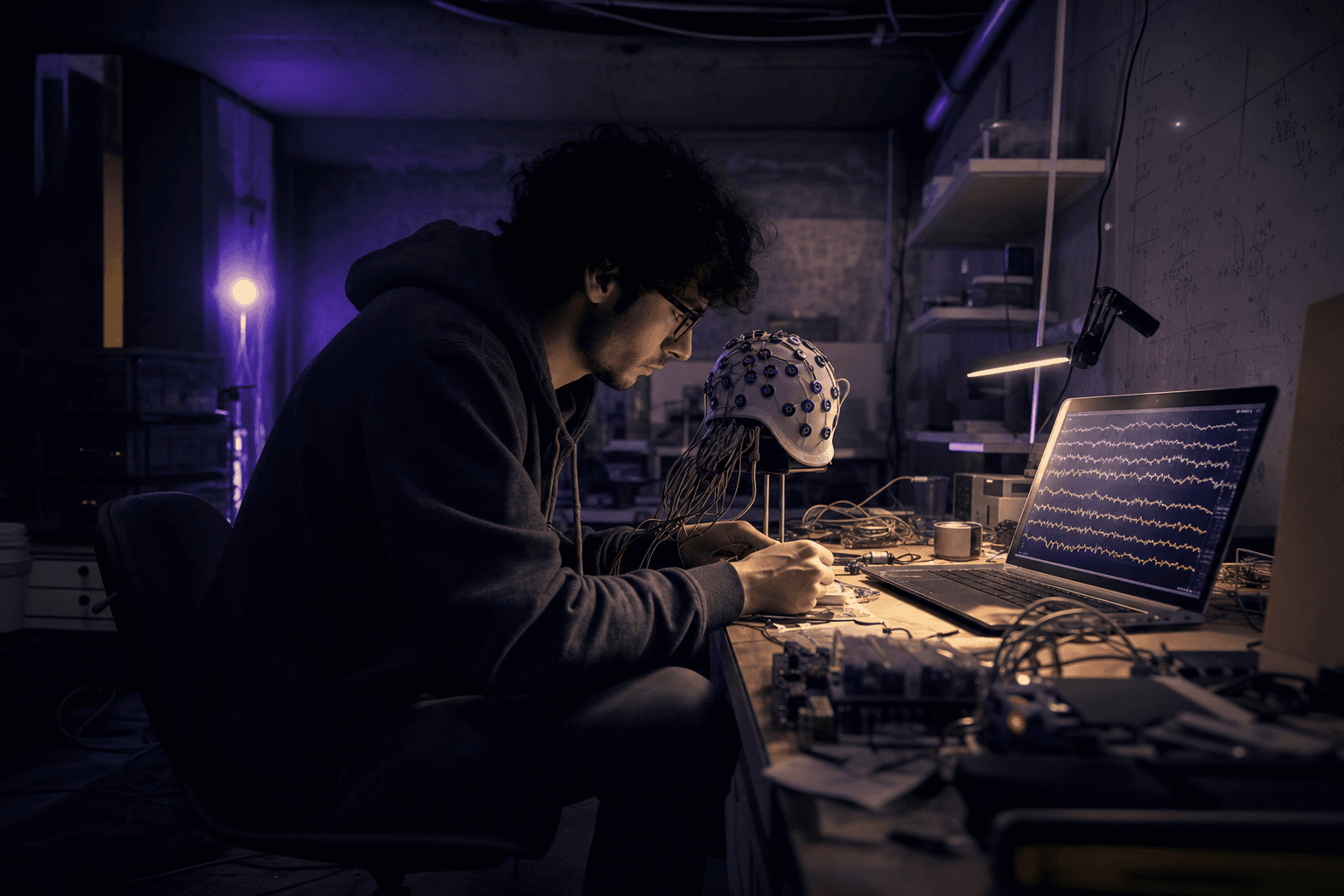
The next generation of BCI companies is being built today, in small rooms and home labs and university basements. They are working on problems that the current generation of visible companies has not yet solved: better non-invasive signal acquisition, whole-brain decoding, neural interfaces for mental health, ultrasound-based approaches that could make implant surgery unnecessary. Some of these founders are building the companies that will define the field in ten years.
They just need to find each other first.

WorldChangers is a BCI startup accelerator — at most 10 early-stage companies per batch. If you're building at the brain-machine boundary, applications for Batch 01 are open.
Building at the brain–computer interface?
Apply to Batch 01